
Learn how to calculate how much paint you need for a room using wall dimensions, coverage, coats, doors, windows, and a practical waste allowance.
Buying too little paint can leave you making another trip to the store. Buying too much can waste money and leave you with containers of paint you may never use.
The better approach is to estimate the area you actually need to cover before buying paint.
What Determines How Much Paint You Need?
The amount of paint depends on several factors:
- wall dimensions
- number of walls
- ceiling height
- doors and windows
- number of coats
- paint coverage
- surface condition
- primer requirements
- application method
Two rooms with the same floor size can require different amounts of paint because their wall heights, windows, doors, and layouts may differ.
Step 1: Measure the Walls
For a simple rectangular room, measure:
wall length × wall height
Then repeat the calculation for each wall.
For example:
A wall is 12 feet wide and 8 feet high.
12 × 8 = 96 square feet
If the opposite wall has the same dimensions, that’s another 96 square feet.
Continue until you’ve calculated the total wall area.
Step 2: Subtract Large Openings
Doors and windows don’t normally need the same wall paint.
If a room has large windows or doors, subtract their approximate area from the total wall area.
This gives you a more useful estimate of the actual paintable surface.
Step 3: Consider the Number of Coats
One coat and two coats don’t require the same quantity.
If your calculated paintable area is 400 square feet and you’re applying two coats, you’re effectively planning coverage for:
400 × 2 = 800 square feet
The actual requirement depends on the paint’s stated coverage and the condition of the surface.
Step 4: Check the Paint’s Coverage
Paint manufacturers generally provide a coverage estimate on the product label or technical information.
Use the manufacturer’s stated coverage rather than assuming every gallon or liter covers the same area.
Coverage can vary with:
- paint type
- surface texture
- color
- application method
- primer
- number of coats
Step 5: Add a Practical Allowance
Real-world projects rarely behave exactly like a mathematical calculation.
You may need additional paint because of:
- textured walls
- absorption
- touch-ups
- uneven surfaces
- waste
- future repairs
Avoid blindly adding a huge percentage, however.
The appropriate allowance depends on the project.
Use a Paint Calculator
If you don’t want to perform each calculation manually, use the Notchful Paint Calculator to estimate the amount required from your measurements.
A calculator is particularly useful when you have several walls, multiple rooms, or different dimensions.
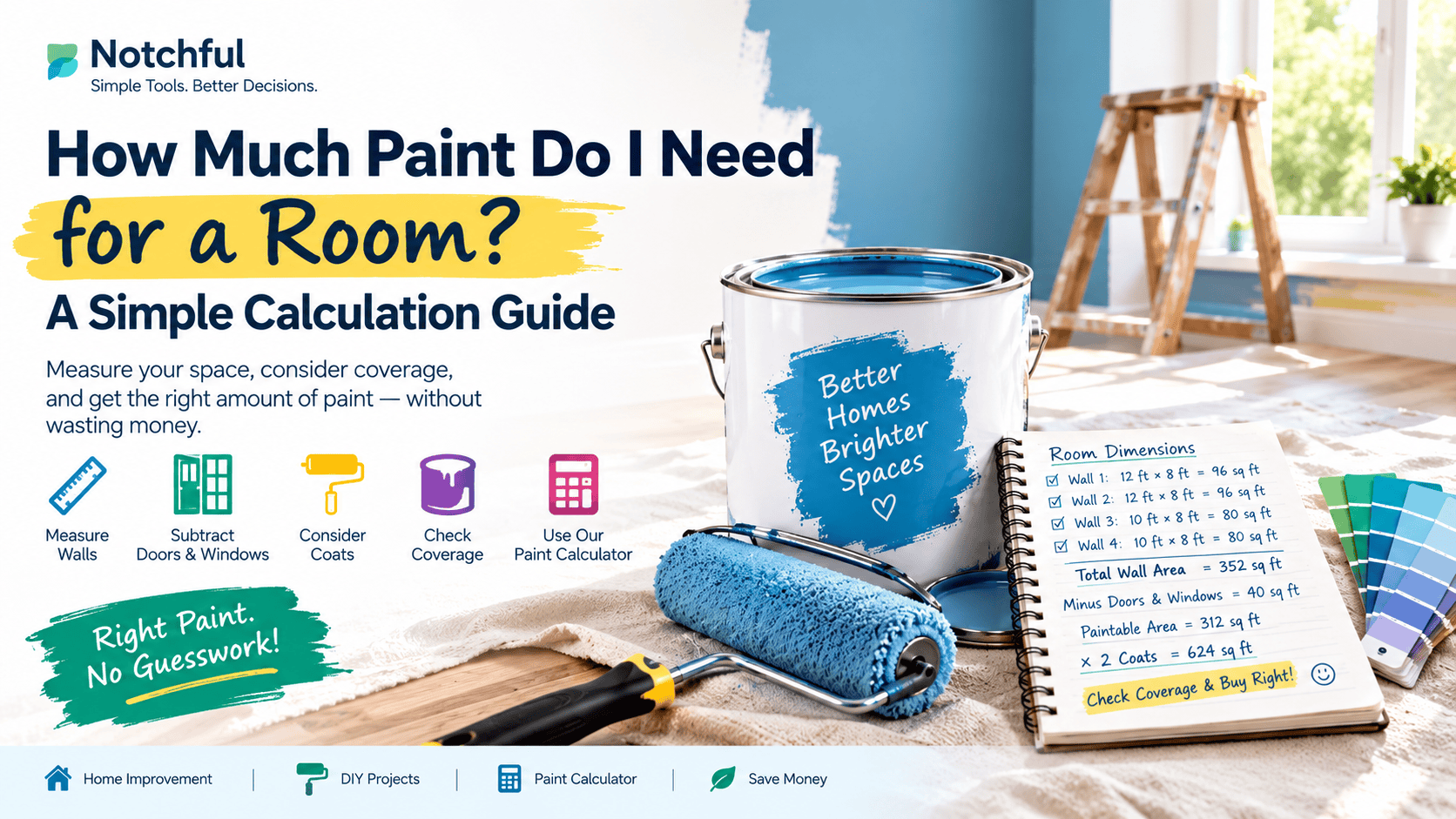
Worked Paint Calculation Example
Imagine a room has four walls:
- 12 × 8 ft
- 12 × 8 ft
- 10 × 8 ft
- 10 × 8 ft
Total wall area:
96 + 96 + 80 + 80 = 352 square feet
If doors and windows account for 40 square feet:
352 − 40 = 312 square feet
For two coats:
312 × 2 = 624 square feet of coverage
You would then compare that requirement with the paint manufacturer’s coverage information.
For a worked example that converts a specific, common room size straight into a gallon count, see our 12×14 room paint guide.
Common Paint Estimation Mistakes
Measuring floor area instead of wall area
A room’s floor size alone doesn’t tell you the total wall surface.
Forgetting ceiling height
Two rooms with identical floor dimensions can require different amounts of paint if their walls have different heights.
Ignoring doors and windows
Large openings can materially reduce the paintable area.
Assuming all paint has identical coverage
Always check the product’s coverage information.
Forgetting the second coat
If you plan two coats, your calculation needs to account for both.
Frequently Asked Questions
How do I calculate paint for a room?
Measure each wall’s width and height, calculate the total wall area, subtract significant doors and windows, account for the number of coats, and compare the result with the manufacturer’s coverage.
How much paint does one gallon cover?
Coverage varies by product and surface, so check the manufacturer’s stated coverage rather than relying on a universal number.
Should I subtract windows and doors?
For a more precise estimate, yes, especially when they occupy substantial wall area.
Should I buy extra paint?
A reasonable allowance can help with touch-ups and unexpected absorption, but avoid excessive overbuying.
Does textured drywall require more paint?
Often, textured or highly absorbent surfaces can require more material than smooth, properly prepared surfaces.
What information should I collect before calculating paint?
Measure wall widths and heights, identify doors and windows, determine the number of coats, and check the paint manufacturer’s coverage information.
Final Takeaway
The most reliable paint estimate starts with actual measurements, not room size alone.
Calculate the wall area, subtract major openings, account for coats, check product coverage, and include a sensible allowance.
Then use the Notchful Paint Calculator to make the calculation easier.
Written by the Notchful team. Figures checked against standard manufacturer coverage rates. Last updated: September 2026.